
The Robot Test: Golf Laboratories Data on the Fire Away Tee
Golfers argue about equipment. Robots don't. This page is the full, plain-English account of what independent robot testing found when the Fire Away Tee went up against conventional tees.
Why we paid a robot to embarrass us (potentially)
Every tee company says their tee adds distance. We wanted a number we didn't produce ourselves. So we sent the Fire Away Tee to Golf Laboratories in San Diego, CA — the independent testing facility whose swing robot is the industry's gold standard for equipment testing — and asked them to test it against competitor tees. A robot swings identically every single time, which removes the golfer, the weather excuse, and the placebo effect from the equation.
The setup
- Facility: Golf Laboratories, San Diego, CA (independent; we paid for the test, we did not run it)
- Method: Golf Labs' precision-engineered swing robot — identical swing, every strike, no human error. Driver swings at a club speed of ~95 mph across every tee tested (95.1–95.4 mph measured), so the tee was the only variable.
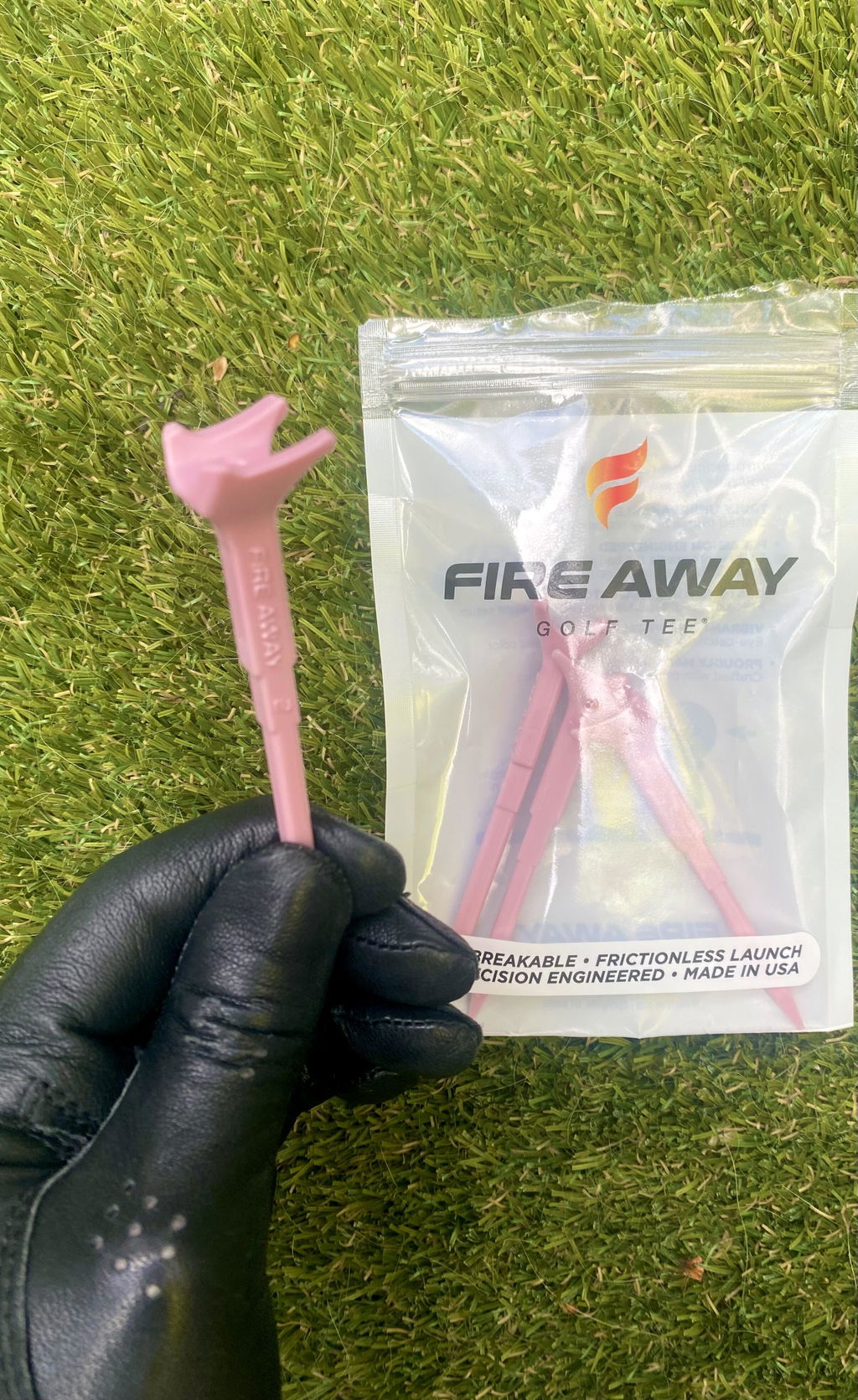
- Configuration: the Fire Away Tee was tested in its forward-lean position — the way it's designed to be played
- Tested against: a leading competitor tee, a Martini tee, and a standard wooden tee
The results
The Fire Away Tee outperformed every other tee tested, in every measured category:
| Metric | Fire Away | Leading Competitor | Martini Tee | Wooden Tee |
|---|---|---|---|---|
| Launch angle (°) | 8.7 ✓ | 7.0 | 7.9 | 7.9 |
| Back spin (rpm) | 2,709.5 ✓ | 2,892.7 | 2,857.5 | 2,711.3 |
| Carry (yds) | 218.9 ✓ | 213.3 | 217.5 | 215.1 |
| Total distance (yds) | 242.4 ✓ | 237.4 | 239.6 | 238.5 |
| Peak height (ft) | 58.0 ✓ | 49.0 | 55.1 | 52.7 |
| Hang time (s) | 6.4 ✓ | 6.0 | 6.2 | 5.9 |

In plain English:
- +5 yards of total distance over the leading competitor tee (242.4 vs 237.4) — and about +4 yards over the average of all three tees tested
- Highest launch angle of the group: 8.7° vs 7.0–7.9°
- Lowest backspin of any tee tested: 2,709.5 rpm
- Best carry, peak height, and hang time — 218.9 yards of carry, 58 feet of peak height, 6.4 seconds in the air
- Not just longer — tighter. Total-distance standard deviation was 1.7 yards for the Fire Away Tee vs 3.1 for both plastic competitors. (Full disclosure: the wooden tee was the steadiest at 0.8 — it was also 4 yards shorter.)
And here's the actual landing-data page from the Golf Laboratories report, standard deviations and all:

Why it happens
Nothing mystical: the patented design changes two physical variables at impact. The 5-degree forward tilt sets the ball's center of gravity back, promoting a higher-launch, lower-spin strike. The four-point cradle holds the ball with minimal surface contact, so there's less friction as the ball leaves the tee. Less friction and better launch geometry → more carry.
The honest caveats
We'd rather over-disclose than be one more equipment ad:
- These are robot-measured averages, not a guarantee for every swing.
- A tee will not fix a slice caused by an out-to-in path. (Consistent tee height will remove one variable from the equation.)
- We commissioned the test. Golf Laboratories ran it independently — that's the point — but you deserve to know who paid.
The part the robot couldn't test
Durability. For that, we have customers: Ed has played the same Fire Away Tee for 18 months. The tee is made from an advanced composite blend that bends and returns to shape instead of snapping — which also means your tee height stays identical from the 1st hole to the 18th, all season.
Questions or press
Want the details or a comment for an article? Email support@fireawaytee.com. Want to test it yourself the old-fashioned way?